The short answer
Choose laser cleaning when targeted rust or coating removal and less blasting media cleanup matter. Sandblasting may fit better when the next coating needs an abrasive surface profile. CLEAR is a continuous-wave fiber laser cleaner, so review heat and base-metal limits when choosing it for thin or delicate parts.
Start with the surface you need
Name the layer you want to remove and the finish you need afterward. CLEAR lists rust, paint, oil and grease, oxide and scale, and weld discoloration among its uses. The base metal and layer thickness affect how the job should run.
Coating removal and coating prep are not always the same task. If the next finish needs a defined surface profile, confirm that the chosen method can meet it. A clean-looking surface alone does not prove it is ready to coat.
Compare media, heat and finish
Laser cleaning uses light to remove material from the surface. Sandblasting uses abrasive media. Both need a plan to collect what comes off the part.
| Buying question | CW laser cleaning | Sandblasting |
|---|---|---|
| Added cleaning media | No blasting media | Uses abrasive media |
| Cleanup | Removed residue and fumes still need collection | Removed material and blasting media need collection |
| Local removal | Handheld head can focus on a selected area | May need masking around the target area |
| Surface profile | Does not replace every abrasive profile requirement | Can create a profile for coating |
| Effect on the base metal | Heat and settings need care | Abrasive action can change texture or wear the surface |
Understand what CW means for CLEAR
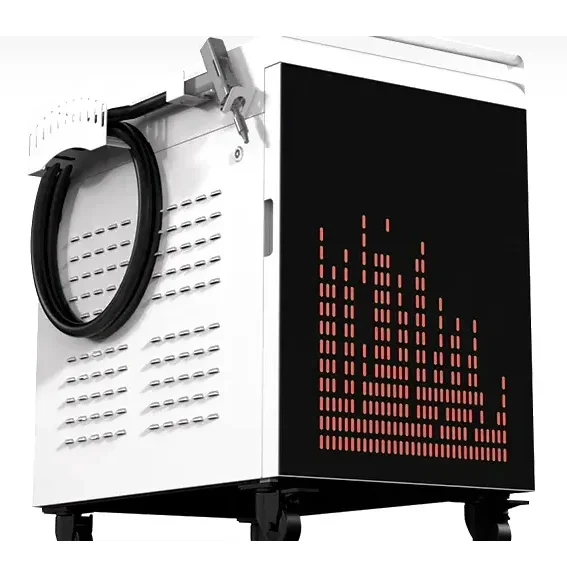
CLEAR is a continuous-wave, or CW, fiber laser cleaner at 1080 nm. It comes in 1.5, 2 and 3 kW versions. It is not a pulsed laser cleaner.
A CW beam adds heat as it works. Dwell time, movement and settings matter on thin or delicate parts. Review the base metal and finish limits before choosing power.
Use cleaning rates as a reference
CLEAR lists the cleaning ranges below. They are not a guaranteed rust or paint removal rate for every surface. Layer thickness, material and the required finish affect the pace.
Use these ranges to start a workload review. Compare removal and cleanup on the same coating and base metal. Include the time needed to reach the finish required for the next step.
| Model | Laser power | Listed cleaning rate |
|---|---|---|
| CLEAR 1500 | 1500 W | 8-40 m²/h |
| CLEAR 2000 | 2000 W | 10-60 m²/h |
| CLEAR 3000 | 3000 W | 20-80 m²/h |
Plan the work after cleaning
Check the surface against the next step's needs, whether that is welding, painting or inspection. Plan extraction and residue collection for the layer being removed. Using no blasting media reduces added media handling, but does not remove the need for cleanup.
CLEAR uses dual-temperature cooling and lists an ambient range of 5-40 °C. Share the metal, coating, area to clean and finish target with an engineer. Those details help match the process to the job.